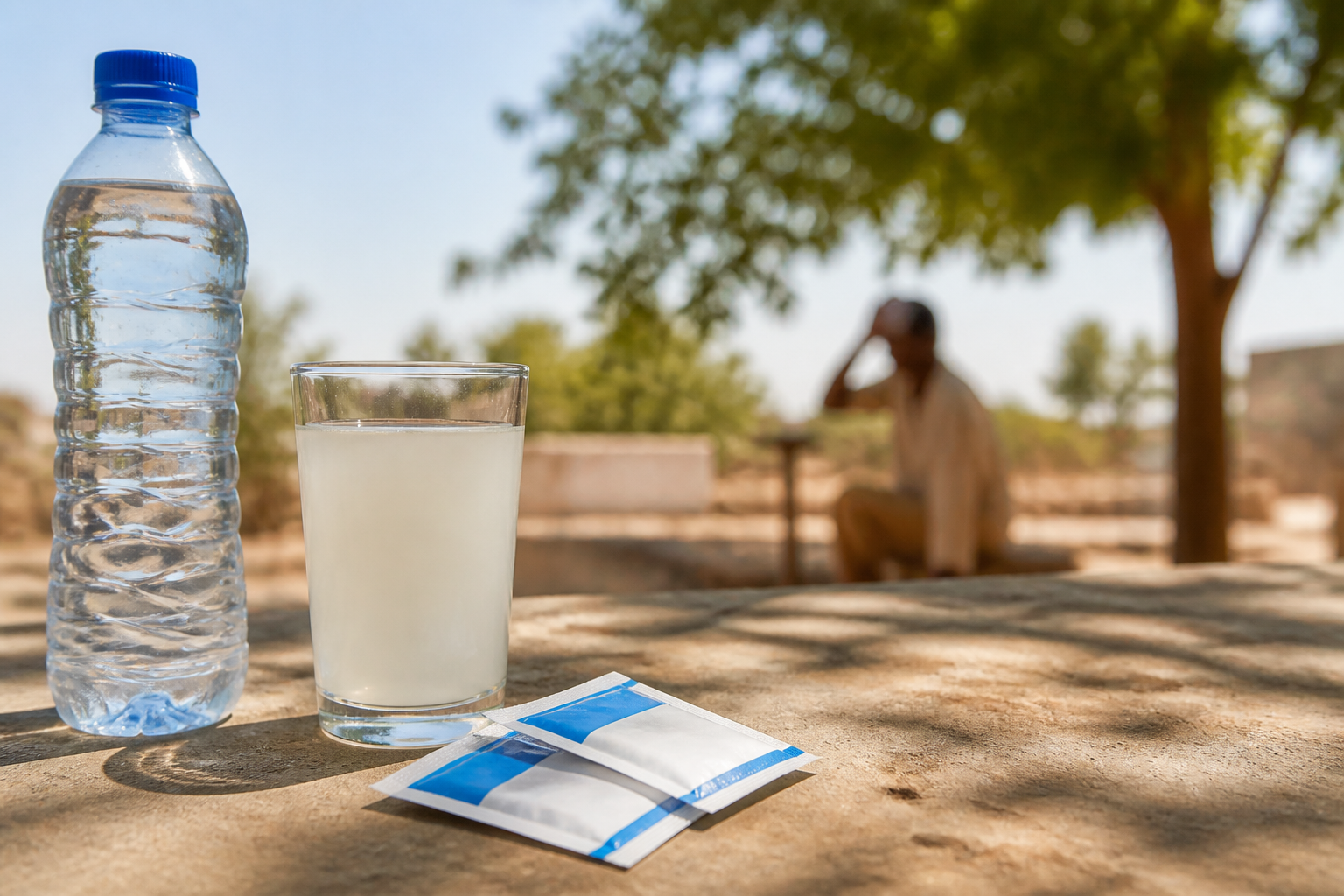
ORS and Dehydration: When to Use, How to Mix, and What to Avoid
WHO-formula ORS, homemade mistakes, signs of severe dehydration, and when IV fluids are needed.
Across Indian households, Oral Rehydration Solution — better known simply as ORS — is one of the most reached-for remedies during bouts of loose motions, vomiting, summer heat exhaustion, or a stomach bug picked up from street food. It is inexpensive, available at almost every pharmacy without a prescription, and genuinely effective when used correctly. Yet it is also one of the most commonly misused home remedies: mixed too strong, too weak, given in the wrong amount, or reached for too late after severe dehydration has already set in.
This guide explains what ORS actually does inside the body, how to mix and dose it correctly for different ages, common mistakes to avoid, and — most importantly — the warning signs that mean ORS alone is not enough and medical care is needed without delay.
Why Dehydration Happens Fast in India
India's climate and common illnesses combine to make dehydration a frequent risk. High summer temperatures increase fluid loss through sweat, even without any illness. Add to this the seasonal spikes in diarrhoeal illness and food poisoning during monsoon months, and the risk multiplies. Fever also increases fluid loss, and reduced appetite during illness often means people are drinking less water at the exact time their body needs more.
Children and elderly adults are especially vulnerable. Children have a higher body-surface-area-to-weight ratio, meaning they lose fluid proportionally faster, and cannot always communicate thirst clearly. Elderly adults often have a blunted thirst response and may be on medicines like diuretics that increase fluid loss further. Recognising early dehydration in both groups requires watching behaviour and physical signs, not just asking "are you thirsty?"
What ORS Actually Does
ORS is not simply salted, sugared water — it is a precisely balanced formula developed and recommended by the World Health Organization (WHO) and UNICEF. The current WHO low-osmolarity formula contains a specific ratio of glucose, sodium chloride, potassium chloride, and trisodium citrate, dissolved in a fixed volume of clean water. This particular combination exploits a mechanism in the small intestine where glucose helps actively transport sodium (and with it, water) across the gut wall, even when the gut is inflamed from infection. This is why ORS rehydrates more effectively than plain water or sugary drinks during diarrhoeal illness — it works with the body's absorption pathway rather than just adding fluid volume.
How to Mix ORS Correctly
Every ORS sachet sold in India is designed to be mixed with a specific, fixed volume of clean drinking water — commonly one litre, though some paediatric sachets are designed for smaller volumes. Always check the exact volume printed on the sachet rather than assuming.
- Use clean, boiled-and-cooled, or safe bottled water — never mix ORS with unclean or unfiltered water, since this can introduce new infection.
- Measure the water volume accurately using a measuring container, not by estimation, since concentration matters for effectiveness and safety.
- Stir until the powder is fully dissolved before drinking.
- Prepare a fresh batch every 24 hours and discard any unused solution after that period, especially in warm weather when bacterial growth in the mixed solution happens quickly.
Common Mixing Mistakes
- Making it too concentrated: Adding less water than instructed (to "make it stronger") actually makes the solution more concentrated in salt and sugar than the body can safely handle, which can worsen dehydration by drawing water out of body tissues into the gut.
- Making it too diluted: Adding extra water to "make the sachet last longer" reduces the sodium and glucose concentration below the level needed for effective absorption.
- Adding sugar, salt, or fruit juice to the mix: This throws off the carefully balanced osmolarity and can make diarrhoea worse rather than better.
- Reusing solution mixed a day or more ago: Bacterial contamination can build up quickly, especially without refrigeration.
How Much ORS to Give, by Age
The right quantity depends on age, body weight, and the amount of ongoing fluid loss from vomiting or loose motions. As a general guide, endorsed by paediatric and WHO guidelines:
- Infants under 2 years: Roughly 50 to 100 ml of ORS after each loose stool or vomiting episode, in addition to continued breastfeeding or usual feeds.
- Children 2 to 10 years: Roughly 100 to 200 ml of ORS after each loose stool or vomiting episode.
- Older children and adults: As much ORS as can be comfortably tolerated after each episode, sipped steadily rather than gulped, typically several hundred millilitres.
Sip ORS slowly and steadily rather than drinking a large amount at once, especially if there is ongoing vomiting, since a big gulp can trigger another vomiting episode. Small, frequent sips — even a spoonful every few minutes for a young child who is reluctant to drink — are more effective than trying to force a full glass at once.
Homemade Alternatives — Use With Caution
A traditional homemade sugar-salt solution (roughly six level teaspoons of sugar and half a teaspoon of salt dissolved in one litre of clean water) can serve as a stop-gap when commercial ORS genuinely is not available. However, it lacks the potassium and citrate found in standard ORS formulations, and measurement errors at home are common and can be dangerous — too much salt can cause serious complications, particularly in young children. Commercial ORS sachets are inexpensive and widely available across India, so they should always be the first choice rather than a homemade mix whenever possible.
Signs of Mild vs Severe Dehydration
Recognising the severity of dehydration helps you judge whether home management with ORS is sufficient or whether you need medical attention.
- Mild dehydration: Mild thirst, slightly dry lips, normal or mildly reduced urine output, alert and active behaviour.
- Moderate dehydration: Noticeable thirst, dry mouth, reduced urine output with darker urine, mild irritability or tiredness, slightly sunken eyes.
- Severe dehydration: Very little or no urine for several hours, sunken eyes, lethargy or difficulty waking, cold or clammy skin, rapid breathing or heartbeat, and in infants, a sunken soft spot on the head (fontanelle).
Red Flags That Need Urgent Medical Care
- No urination for 6 hours or more (or significantly reduced wet nappies in infants)
- Persistent vomiting that prevents keeping any fluids down, including ORS
- Blood in stool or vomit
- High fever alongside diarrhoea or vomiting
- Extreme lethargy, confusion, or unresponsiveness
- Sunken eyes, sunken fontanelle in infants, or skin that stays "tented" when gently pinched
- Diarrhoea lasting more than two to three days without improvement
Any of these signs mean it is time to move beyond home ORS management. Severe dehydration often requires intravenous (IV) fluids administered in a clinic or hospital, because the person may no longer be able to absorb enough fluid by mouth quickly enough to recover safely.
What to Avoid While Rehydrating
- Carbonated soft drinks and packaged fruit juices — these are high in sugar and low in the electrolytes the body actually needs, and can sometimes worsen diarrhoea due to their high osmolarity.
- Anti-diarrhoeal medicines in young children without a doctor's specific advice — these can mask the body's natural clearance of infection and are generally discouraged in paediatric diarrhoea.
- Skipping food entirely for long periods — age-appropriate, easily digestible food (like khichdi, banana, or plain rice) alongside ORS supports recovery better than prolonged fasting, once vomiting has settled.
- Relying on ORS alone for underlying causes that need treatment, such as a bacterial infection that may require specific medical management.
Storing ORS at Home
Unmixed ORS sachets have a reasonably long shelf life and are worth keeping in every household first-aid box, especially during summer and monsoon months. Store sachets in a cool, dry place away from direct sunlight and moisture, and always check the printed expiry date before use. Once mixed with water, use within 24 hours and discard the rest — do not store made-up ORS solution for the next episode "just in case."
How Your Pharmacist Can Help
At MedsNMore, our pharmacists can guide you on choosing the right ORS formulation for your family's needs, including paediatric options, and can help you understand correct mixing volumes for the specific sachet you have purchased. They can also advise on when zinc supplementation (commonly recommended alongside ORS for children with diarrhoea) may be appropriate, and flag situations where symptoms suggest you should see a doctor rather than continue home management.
Frequently Asked Questions
Can I give ORS to a baby under six months old?
Yes, ORS can be given to infants, but breastfeeding should continue alongside it and quantities should be smaller and more frequent. It is best to confirm exact quantities with your paediatrician for infants, especially newborns.
Is it fine to add ORS to milk or juice?
No. ORS should be mixed only with clean water in the exact volume specified on the sachet. Mixing it with milk, juice, or other liquids changes its concentration and reduces its effectiveness.
How long can diarrhoea continue before it becomes a medical emergency?
Diarrhoea lasting more than two to three days without improvement, or accompanied by blood, high fever, or signs of severe dehydration, needs prompt medical evaluation rather than continued home management alone.
Can adults use the same ORS sachets meant for children?
Generally yes, since the formula concentration is the same — what differs for children is usually the total quantity given per episode, not the mixing ratio itself. Check the packaging for any specific paediatric instructions.
Does ORS stop diarrhoea?
No, ORS does not treat the underlying cause of diarrhoea or stop it directly — it replaces lost fluids and electrolytes to prevent dehydration while the body's immune system clears the infection. If diarrhoea persists, a doctor may need to identify and treat the specific cause.
What if my child refuses to drink ORS because of the taste?
Try offering it slightly chilled, in small frequent sips through a straw or spoon, and avoid mixing it with other flavours. If a child consistently refuses and shows signs of worsening dehydration, contact a doctor promptly rather than persisting alone.
Disclaimer
This article is for general educational purposes only and does not replace professional medical advice, diagnosis, or treatment. Dehydration, especially in infants, young children, and elderly adults, can worsen quickly and may require urgent medical care. Always consult a doctor for persistent, severe, or concerning symptoms, and seek emergency care immediately if any red-flag signs described above are present.
Comments
Start the conversation
No comments yet. If you have a practical note for other readers, add it below.